Helpful Hints for Maintaining your Water Garden
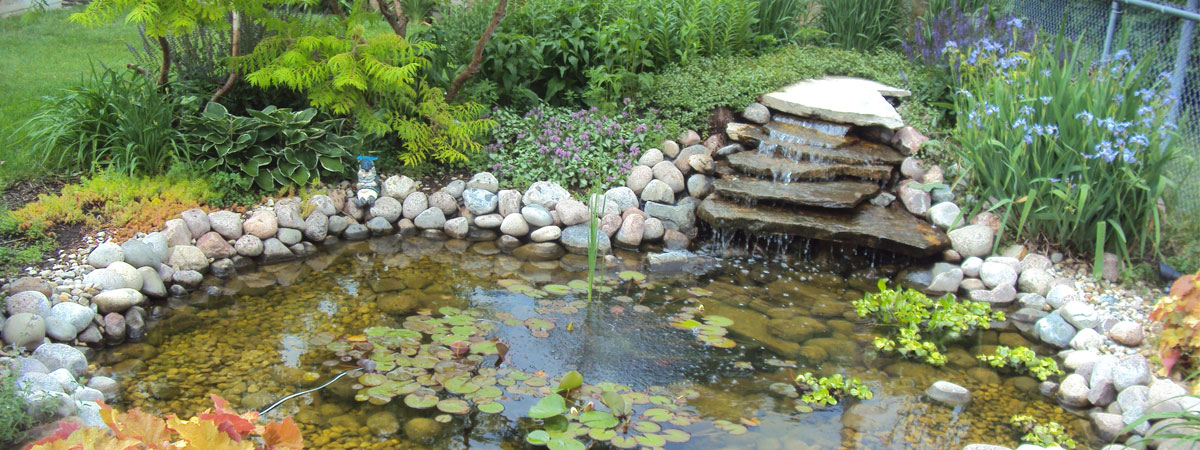
Northeast Nursery’s water garden department has grown considerably in recent years. Our knowledgeable and friendly staff, combined with recent upgrades to the department make Northeast Nursery a perfect one-stop-shopping destination for all of your pond needs.
Whether you are an experienced pond builder or a homeowner eager to learn about the excitement a water garden adds to your landscape, we are the place for you. In addition to our vast product line we also possess the knowledge to guide you through every step of the pond process. From the initial planning stage to any pond maintenance issues you may have, we are here to help.
Facts and Formulas
- To determine the surface area of a rectangular pond:
Length of pond in feet X Width of pond in feet = Surface Area (sq. ft.)
- To determine the surface area of a circular pond:
Radius of pond in feet X Radius of pond in feet X 3.14 = Surface Area (sq .ft.)
- To determine the volume of a pond in gallons:
Surface area of the pond (sq .ft.) X Average depth in feet X 7.5 = # Gallons
- To determine the amount of liner needed:
Maximum width(ft.) + Twice the maximum depth(ft.) + 2 ft. = Width Needed
Maximum length(ft.) + Twice the maximum depth(ft.) + 2 ft. = Length Needed
- To minimize water quality problems, we suggest stocking no more than 1” of fish per cubic foot of water (53 cubic feet = 8-10 fish, 4-5” in size).
- Filter pumps should circulate the pond every 2 – 4 hrs. Effluent type (solids handling) pumps are best for filtration.
- To estimate water volume required for a waterfall or stream, use the basis of 100 GPH per inch of width (1200 GPH for a 12” wide waterfall). This provides a minimal (+/- ¼” deep) sheet of water. For a “heavy” flow and for streams, multiply this figure by 2, 3 or 4. Be sure channel edges are high enough to contain this water flow.
- Pump flow rates, using flexible, non-kink tubing as large or larger than the pump’s outlet, are determined by the VERTICAL lift. Measure from water surface in the base pool to the highest point of outlet.
- To maintain a healthy natural balance in a pond:
- use one bunch of oxygenators for every 1-2 sq .ft.
- cover 60% of the water surface with a combination of water lilies, floating plants, such as hyacinths and marginal plants.
- Add one Japanese Trapdoor Snail for every 1-2 sq .ft
- See more at: http://www.northeastnursery.com/water/helpfulhints.html#sthash.xkaGHMmL.dpuf