Caring for your Pond
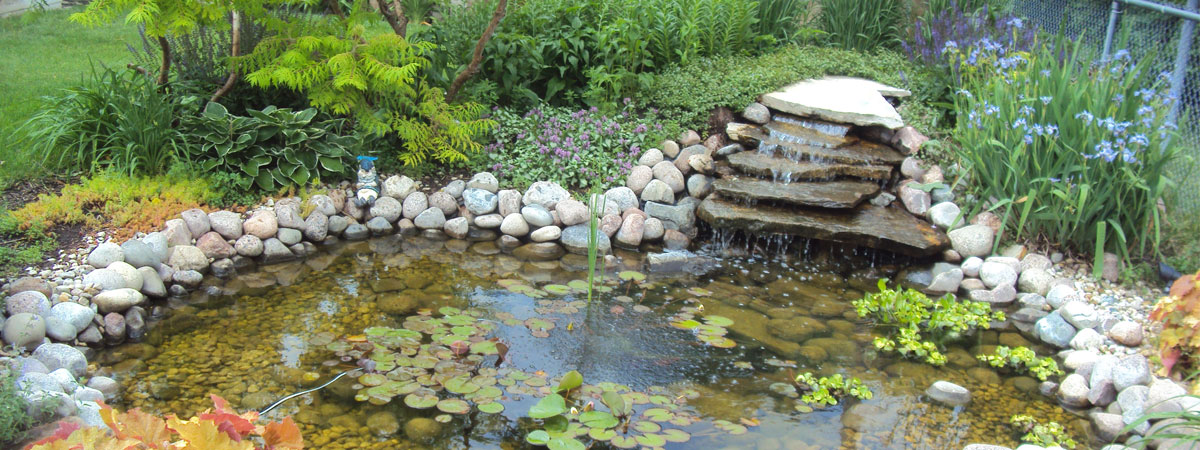
Northeast Nursery's water garden department has grown considerably in recent years. Our knowledgeable and friendly staff, combined with recent upgrades to the department make Northeast Nursery a perfect one-stop-shopping destination for all of your pond needs.
Whether you are an experienced pond builder or a homeowner eager to learn about the excitement a water garden adds to your landscape, we are the place for you. In addition to our vast product line we also possess the knowledge to guide you through every step of the pond process. From the initial planning stage to any pond maintenance issues you may have, we are here to help. Click here for our organic pond care line by Organica.
Fall/Winter Pond Clean-up
September:
Give your plants their last dose of fertilizer tablets
Remove dead plants (i.e. tropical's such as lettuce and hyacinths)
Remove debris from bottom of your pond with skimmer net.
Transplant some of your lilies and marginal plants. Remember larger containers mean larger plants.
October/November:
Fish owners need to be aware of the winter needs of their pets, especially concerning water. Filters should be running to remove particles, convert ammonia and to oxygenate the water. Your fish?s metabolism will start to slow down when the nights get colder (temps below 40). Alter your fish’s diet by feeding them low calorie wheat germ based food. The larger the fish population, the more serious the need for supplemental filtration and oxygenation?oxygenating plants go dormant. Some pond experts find it desirable to do a partial (50%) water change at this time. This reduces toxic gases and increases the oxygen levels of the water. Balance your PH levels.
December:
Install a pond deicer to maintain a hole in the ice of your pond. This will allow the toxic gases that are produced by your fish to escape. Remember the cold will not harm your fish but the risk of toxic poisoning as a result of suffocation will.
Spring Pond Clean-up
-
Visually inspect your filter, tubing, water runs, etc. for any winter disturbance. Clean any pump, pre-filter and turn your pump and filter on. As it begins to flow, use a rugged fish net or a vacuum to remove any leaves, twigs or other trash from the pond. Any silt or fine organic debris stirred up can be dealt with by the filter. Inspect your fish for health, your plants for growth (the need to divide and repot) and your water flow for any leaks.
-
Test your water quality (if you have fish) and correct if necessary. My preference is to avoid any arbitrary water changes and rather to develop an ecologically balanced pond environment ? I?d rather work with Mother Nature than fight her! I like to add some nitrifying bacteria and some Organica Pond Clarifier, Clean-Out or Pondzyme at this point (this is helping Mother Nature) to head off any subsequent water quality problems. The addition of a ?pond dye? such as Algae Blocker or Aquashade will block the UV rays and inhibit the growth of algae at this time when there is no surface plant cover. Check your water temperature and if over 42 degrees F, it will be mutually satisfying to (sparingly) feed your fish with a special Spring Fish Food. This might be a good time (they will tolerate light ice build-up) to put your Water Hawthorne into the pond. They love spring temperatures and will reward you with many fragrant blossoms before they take ?their summer vacation?.
-
As growth begins to appear, do any repotting or dividing. Use an Aquatic Soil (heavy clay-type loam mixed with compost) and containers appropriate to your plants and the size of your pond. Lift your marginal plants and lotus onto their shelves or pedestals (appropriate depth for the growing season) ? water lilies will blossom earlier and longer if lifted to a 6-12? depth. Use Pondtabbs to fertilize your water lilies and lotus at this time. Oxygenating plants and scavengers such as Japanese trapdoor snails or Bullfrog tadpoles should be added as warranted to ?beef up? your pond?s natural (algae fighting) balance. If your water is cloudy, check your filter (clean if needed) and add some Poly-Clear or Accu-Clear.
-
When water temperatures reach the 60?s, you may add some Water Hyacinths so that they may begin their seasonal work as the growing season allows. Tropical marginal plants may be put into the pond when the likelihood of a serious frost has passed ? warm water temperatures will protect your Hyacinths from any light frosts. Tropical Water lilies, Water Lettuce and Sensitive Plant all require very warm water ? at least the low 70?s ? best to be patient here since Mother Nature has been known to be rather fickle.
-
Throughout #2-4 above and most particularly as soon as the first bud is visible I strongly recommend a daily inspection ? preferably a good 30 minute (or longer) viewing.
Care of Koi and Goldfish
When you are planning and building your garden pond, there is no magical depth of water in which fish will magically survive. A simple fact however is that a 6? fish will pollute one cubic foot of water much faster than it can pollute two or three cubic feet of water. While water lilies require surface area, your pond fish require total water volume.
Naturally, you?ve kept the pond water clean and healthy and now it?s August. Feed your fish well so that they will build up strength for the long, cold winter. We suggest feeding them once a day and as much food as they will eat in 5 minutes. You?ll need to stop feeding Koi when water temperatures fall below 55 degrees and Comets very soon thereafter - they can?t digest the food at lower temps! If they seem hungry during ?Indian Summer?, you can feed them a little duckweed, cooked spinach, Cheerios, cooked pieces of spaghetti, or a special fall/winter fish food. Water lettuce, excess oxygenating plants, any old leaves and water hyacinths should be removed in autumn. Pond-Zyme might be used at this time also. Tree leaves should be skimmed out regularly. Your filter should be cleaned and operating at peak efficiency.
It is a great idea to run the filter as long as possible. Some people even run a pump all winter to keep an air exchange going, (positioned close to the water?s surface). Without human and/or mechanical intervention, the pond will soon ice over. Ice floats and water is heaviest at 39 degrees, so your water temperature is in this range any time you see ice. But if you ?mess with Mother Nature? by circulating the water, you eliminate that nice 39 degree layer at the bottom of the pool. Elevate the pump on a pedestal at least half way to the surface.
Assuming you have a clean pond and healthy water, you should keep some open surface area to allow toxic gases to escape. This is best achieved by using a pump to aerate the water and using a pond ?DeIcer? to help maintain that bottom layer of warm water. The DeIcer should be unplugged before all the ice is melted to prevent the stress of the fish further with a false spring.
Fish come out of the winter ?run down? and ?stressed out? ? easy prey for disease and parasites. Feed carefully as noted above at appropriate water temps, but keep an eye out for sickness. Any infected fish should be removed for a salt bath. Medical intervention should only be taken in isolation tanks and/or with the advice of a Veterinarian.
In nature, fish will survive at low stocking densities ?naturally?. When fish grow to the extent that they pollute their winter quarters, nature ?thins them out?. In either case, a little care and fore-thought go a long way in maintaining a healthy and enjoyable fish population.
Water Quality for Plant Health
Water quality for drinking water purposes is much different than the water quality for plant health purposes. The pH levels, as well as carbonate hardness are factors and testing is important, particularly when rainwater is a substantial portion of the contents of the pond. For pH adjustment and carbonate hardness (buffering) we are using Baking Soda as a better alternative for plant health. Well water may be adequate for the plants but certainly does not contain the blend of nutrients that leads to vigorous healthy plants. Municipal water sources are chlorinated and at a bare minimum, require the use of a dechlorinization treatment.
Plants will benefit from the addition of micro nutrients into the pond water, Water Garden Grow by US Aqua garden or Aquatic Plant Stimulant by Aquarium Pharmaceuticals. These products contain no macro nutrients but do contain a mixture of essential micro nutrients, which may or may not be available in your water supply and are definitely lacking in the rainwater. Calcium may also be lacking (consumed by Snails and Nitrifying bacteria). The ideal range seems to be 40 PPM.
Recognizing the complex ecology of ?balanced? pond water, we have endeavored through good general hygiene and periodic filtration to avoid water changes as much as possible. We tolerate a small amount of silt sediment and organic matter so as to maintain that existing balance of nutrients. This provides a more natural habitat for the plants and quite obviously contributes to overall plant and fish health.
In maintaining existing water quality and treating ponds that have been filled with fresh water or, worse yet, rain water, we have added Organica Pond Clarifier or Microbe Lift in order to build up the microbial population both to digest organic matter in the ponds (maintains better water clarity and visual appearance as well) and also to re circulate the nutrients in that organic matter to make them available for further plant growth. Water Hyacinths and other rapidly growing free-floating plants will consume both nutrients and micro nutrients with rapidity.
We have seen such vigorous growth and such miniscule amounts of any type of plant disease with this regimen that we treat all pools as above and encourage you to do likewise. If your plant inventory pools have been drained for cleaning or removed to winter storage (hence they need to be refilled in the spring) we do strongly suggest that you utilize some water from your existing display gardens that would be established pond water? and treating both display and inventory pools, per the above suggestions, as you fill them up.
As horticulturists, we know better to take a healthy established Azalea plant and plant it into sterile inhospitable beach sand, so why should we presume that tap water and good pond water are in fact interchangeable?
Aquatic Plants for Special Purposes
H = Hardy T = Tropical
Algae Control - Water Hyacinth, Azolla, Salvinia (T), Elodea (H), Moneywort (H), Floating Heart (T)
Color - Waterlilies (tropical or hardy), Lotus (H), Variegated Canna (T), Taro (T), Iris (H), Chameleon Plant (H), Water Hyacinth (T), Moneywort (H), Water Poppy (T)
Fish Spawning - Cabomba (H), Elodea (H), Hornwort (H)
Fragrance - Water Hawthorne (T), Waterlilies (H), most tropical lilies
Oxygenation - Elodea (H), Hornwort (H), Cambomba (H), Vallisneria (H), Moneywort (H)
Partial Shade - Some waterlilies (H), Water Hyacinth (T), Moneywort (H), Variegated Canna (T), Variegated Sweet Flag (H), Forget-Me-Not (H), Variegated Ribbon Grass (H), Water Hawthorne (T), Watercress (H)
Shallow Pools (12" or less) ? Waterlilies (H), Water Poppy (T), Water Hyacinth or Lettuce (T), Golden Club (H), Elodea or Cabomba (H), most marginals (H or T)
Tub Gardens Water Poppy (T), Smaller Waterlilies (H), White Snowflake (T), Lotus (H), Corkscrew Rush (H), most short to medium marginals (H or T)
Turbulent Water - Parrots Feather (H), Water Mint (H), Forget-Me-Not (H)
Vertical Accent - Cattails (H), Sweetflag (H), Horsetail (H), Iris (H), Lotus (H), Canna (T)
Wetland Filters - Water Hyacinths (T), Green Taro (T), Fairy Moss (T), Cattails (H), Hemerocallis fulva (H), Umbrella Palm (T), Water Celery (H)