Transplant Alert! Late Blight on Tomatoes and Potatoes
Late Blight on Tomatoes and Potatoes
Gardeners and Landscapers need to be on the look out for Late Blight, a plant disease caused by Phytophthora infestans, which is a very destructive and infectious disease that kills tomato and potato plants gardens around the eastern U.S.
Late blight is the same disease that caused the Irish Potato Famine in the 1840s. It not only threatens home gardens, but also the thousands of acres of commercial potatoes and tomatoes that are grown in Massachusetts and across New England. The disease has been diagnosed on tomato transplants (also referred to as "starts") throughout the Northeast. Infected plants were originally distributed throughout the region by several plant retailers. This disease is not seed borne however, it is exceptionally contagious, and can spread to tomato plants on retail shelves not involved in the original and initial source of the inoculum. Unfortunately, once Late Blight appears in a garden, it can destroy an entire season's crops and remain in the soil for years after.
Late blight, affects both potato and tomato crops. It produces spores very rapidly and these move very easily from one garden or field to others. Spores are easily carried in wind currents to infect susceptible plants in even the most remote areas in our region. All tomato and potato plants grown in home gardens and in commercial fields are susceptible to late blight!
How to Detect Late Blight in your Garden
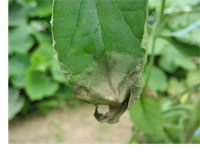 The most common early symptoms on tomato transplants are brown lesions on stems, with white fungal growth developing under moist conditions.
Symptoms appear as large (at least nickel-sized) olive-green to brown spots on leaves with slightly fuzzy white fungal growth on the underside when conditions have been humid or wet. Sometimes the lesion border is yellow or has a water-soaked appearance. Leaf lesions begin as tiny, irregularly shaped brown spots. Brown to blackish lesions also develop on upper stems. Firm, brown spots develop on tomato fruit.
Late blight can be confused with Early Blight and Septoria Leaf Spot, two common diseases found in home gardens. If the lesion has a yellow border and is occurring on the bottom of the plant, it is likely due to infection of either early blight or Septoria leaf spot.
Information provided by: UMass Extension Landscape/Nursery/Urban Forestry Program